



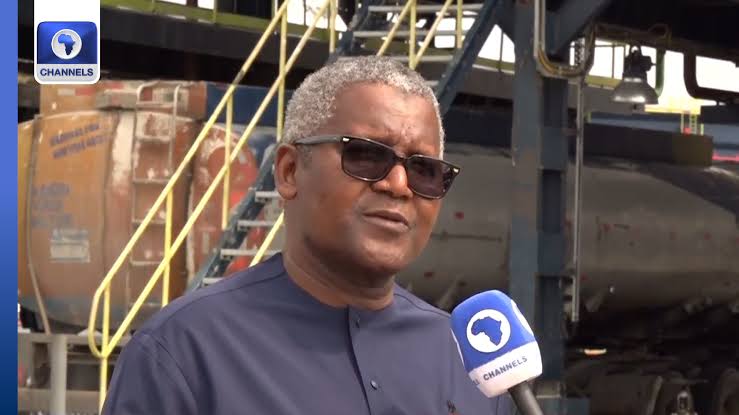

For the first time, Nigerians will gain a clear understanding of the country’s actual fuel consumption, according to Aliko Dangote, President of Dangote Group. This announcement comes as Dangote officially confirmed the rollout of Premium Motor Spirit (PMS), commonly known as petrol, from the world’s largest single-train refinery with a capacity of 650,000 barrels per day.
Reflecting on the achievement of starting PMS production 28 years after Nigeria’s four refineries ceased domestic refining, Dangote, speaking to the press at the refinery in Ibeju-Lekki, Lagos, emphasised that this development will boost the industrial and manufacturing sectors. He highlighted that the refinery will significantly reduce fuel imports, saving foreign exchange, and will contribute to stabilising the naira, lowering inflation, and reducing the cost of living.
monitor loaded ships. This will allow us to precisely determine consumption patterns, though that’s a topic for another discussion.

“Today, we are here to celebrate and give thanks to God Almighty for bringing us to this point where we can produce gasoline. Many doubted we would achieve this, but we have delivered.
“We owe a debt of gratitude to the President and his government. Without their support, we wouldn’t be where we are today. I believe this refinery will transform not only Nigeria but also the entire Sub-Saharan Africa. Our capacity will not only meet Nigeria’s needs but also serve the demands of the broader region.”
Displaying a sample of the PMS to the press, Dangote remarked, “This petrol might be a bit cleaner compared to what we had before. It’s of the highest quality, ensuring that your vehicle’s engine will last longer. The quality of this fuel can match any premium standard worldwide, including those in Europe and America. No one can surpass us in terms of quality. Today is truly a celebration for us Nigerians.
“We are committed to ensuring that starting in October, there will be no need to import polypropylene. Our petrochemical plant will be fully capable of meeting all local demands,” Dangote stated.

While assuring that the refinery will guarantee the availability of petrol in Nigeria, Dangote clarified that the nation’s oil company, the Nigerian National Petroleum Corporation Limited, NNPCL, is responsible for controlling petrol pump prices.
He described this development as a significant turnaround for the country, ending years of not producing a single litre of petrol domestically. Dangote emphasised that while he can ensure a steady supply of fuel from the refinery, the NNPC will manage pricing.
“Pricing is controlled by NNPC. For now, we focus on ensuring that the products are available—that’s what I can guarantee,” Dangote said.
